Talkin’ about Taillights
Clarifying Confusion about Taillight Functions
by Steve Watson
What do taillights really do?
As people add turn signals to their old street rod or as they do more major modifications by changing or adding
lights, they often become confused about the circuitry of the taillights. For full visibility at the rear of the vehicle
we need three distinct functions: (1) the taillights that allow us to be seen from the rear, (2) the brake lights that
notify drivers behind us that we are stopping or slowing down, and (3) the turn signals that advise of turns and
lane changes. In recent years a center or 3rd brake light has become standard on modern cars, and drivers
today are conditioned to look for them. Confusion arises because of the numerous ways to achieve the end
results and in making sure that you have the right combination of parts that work together.
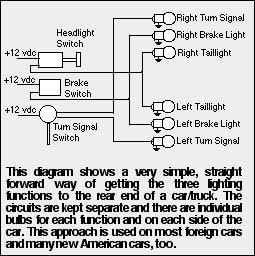
The straightforward way to get three different functions would be with three different bulbs either within each
lamp housing or clustered on each back fender. This is exactly what is done with many European and
Japanese cars as well as many newer Detroit vehicles. The turn signal lenses may be either red or amber to
stand out, and the signal flashes independently of the other two lights. This approach has the advantage of
keeping both brake lights working even when the signals flash. It also makes for a very simple turn signal
switch – a three-position switch (left turn, off, right turn). The down side is that it takes a bit more wire and a lot
more space. Can you visualize 6 teardrop taillights across the back end of a ’34?
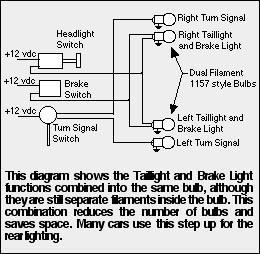
So how do we reduce the number of bulbs? Let’s have a two-for-one sale. By putting two filaments into a
single bulb, like an 1157 bulb for example, we can reduce space and still maintain three distinct functions. The
turn signal bulb is still often left as a separate function so as to retain all of the benefits we listed before. Then
the taillight and brake light become the two different filaments in the 1157. We still have three light filaments to
give us our three functions, but we’ve saved 33% of the taillight housing space needed. Unfortunately, it still
leaves us with 4 teardrops across the back end of our ’34.
Simplification makes things more complex.
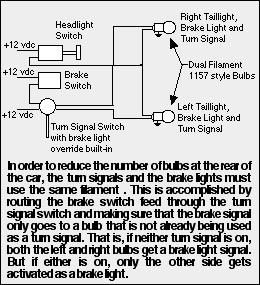
It would really be nice if we could further reduce the number of bulbs and get down to one per side. To achieve
this we need to, somehow, “combine” two of the functions so that they can be done by the same bulb filament.
In that way, two filaments give three functions. If the brake lights are ON, we really don’t need the taillights
because we will be seen anyway. But combining those two functions won’t work because using the same
filament for brake lights and taillights would make them the same brightness. We would push on the brakes
and it would look exactly the same as with just the taillights on. The same would be true trying to combine the
taillights and the turn signals. So the only two functions that we can combine are the brake light and the turn
signal because they are the same brightness and could use the same bulb filament.
That combination still has a draw back. If we have one of the turn signals on and flashing, and then we push on
the brake lights, the brake light will provide a constant voltage to that filament and cancel out (or override) the
flashing turn signal. To fix this brake light override, we need some mechanism that will detect when a turn
signal is ON and that will not allow the brake light to feed that light. So, for example, while the right signal
flashes, the left brake light works but the right turn signal isn’t overridden by the brake. This way a specific bulb
can be a taillight and brake light -or- a taillight and turn signal, but not both at the same time.
Detroit tackled this problem when they first introduced turn signal to cars. They had been using 1157 dual
filament bulbs for years to give them taillights and brake lights in one single bulb. And, for good reason, they
wanted to keep that ability. So when they designed the new switch for the turn signals, they built the brake light
override mechanism in as part of the mechanical turn signal switch. And since that made the whole switch
rather large, they hid it inside the new, larger steering column. This minimized the changes caused by the
addition – new steering column with switch, separate feed wires for each rear brake/turn filament. The taillights
and license plate light could still be fed by just one jumpered wire. Great! Now we’re down to just two
teardrops!
But when we retrofit our ’34 street rod with a new turn signal switch, we may not want to change the steering
column just to get the switch with override capability. A nice stiletto column was more to our liking. The solution
is to achieve the same results electrically.
Wiring in your 3rd Brake light
Evan a rat rod purist would have to admit that getting rear-ended would make for a really bad day. Drivers
today have been conditioned to see the center mounted 3
rd brake light on the car in front of them. Anyone
under the age of 40 has spent their entire driving experience reacting to those centered brake lights. Without
one on your vehicle you’re asking for trouble.
There are a wide variety of aftermarket 3rd brake lights available today. Watsons StreetWorks has several
styles ranging from billet pedestal units to flush mount kits you mold into your bodywork.
Wiring these or any 3rd brake light into your cars lighting system is actually pretty simple. Many aftermarket
wiring kits sold today have a wire dedicated for this. If you’re retrofitting one to your older car the simple thing
to do is pick up the power after brake light switch but before it feeds into the turn signal module on the column.
Thank you so much for this article. I have been searching high and low for a way to wire my car’s rear lights just this way.
Dutch
I have searched for this information for a long time, Thank you for providing a clear and concise explanation of the how and why the dual filament 1157 is used to convey 3 signals. My current problem is definitely in the brake override section of the turn signal mechanism in the steering column. Thanks again.
Ben
Great explanation of how “combined” tail light brake/turn dual element 1157 bulbs are controlled by factory wiring/devices located in the steering column. Takes the mystery out of that. Now I know how to reconfigure my 1997 Motorhome dual taillights 12 bulbs and wiring. Thank you.





Thank you so much for this article. I have been searching high and low for a way to wire my car’s rear lights just this way.
I have searched for this information for a long time, Thank you for providing a clear and concise explanation of the how and why the dual filament 1157 is used to convey 3 signals. My current problem is definitely in the brake override section of the turn signal mechanism in the steering column. Thanks again.
Great explanation of how “combined” tail light brake/turn dual element 1157 bulbs are controlled by factory wiring/devices located in the steering column. Takes the mystery out of that. Now I know how to reconfigure my 1997 Motorhome dual taillights 12 bulbs and wiring. Thank you.