

Custom Cars, Classic Cars, Hotrods, Streetrods, Roadster, Rod, CUSTOM CARS, CLASSIC CARS, HOTROODS, STREETRODS, ROADSTER, ROD, custom cars, classic cars, hotrods, streetrods, roadster, rod, hot rod, street rod, Antique, Automotive, Automobile, Vehicles, auto, aluminum trim, latch releases, hood deck, lights, indicators, LEDS, switches, license plates, power lock triggers, actuator, remote controls, latches, wiring kits, accessories, battery disconnect, brake switch, relays, radiators, catches, cable releases, VW, fiberoptic
Street Rod & Custom Car Products - Toll Free (866) 859-0513, 9-5 M-F EST

Remote Controls and Relays

by Steve Watson, Watson's StreetWorks

Remote controls are definitely the hot electronic item in street rodding these days. That's probably due to their increasing use in new cars, their convenience and the lower prices of the last couple of years. And they're versatile -you can use them to lock and unlock doors like new cars, trigger door latch releases for shaved door handles, run power windows and even to control a battery disconnect, just to mention the most common uses.

In all of those cases, the remote control itself is doing exactly the same thing. You push a button on the transmitter and it sends a coded radio frequency wave to the receiver which closes a contact and puts out an electric signal for as long as you hold the button on the transmitter. In fact, with most remotes, that electric signal is a grounding output of only a couple hundred milliamps. So how in the world can you use that output to do all of the stuff we mentioned? Relays, son, relays!

It seems that I've been preaching the subject of relays for a few years now. Most of that has to do with the increasing stress we're putting on car electrical systems due to higher amperage loading. Halogen headlights and taillights, air conditioning, door releases, power this and power that all demand electricity. If the electrical system or anyone of it's components isn't up for the task, you've got problems. Relays can help to solve those issues.

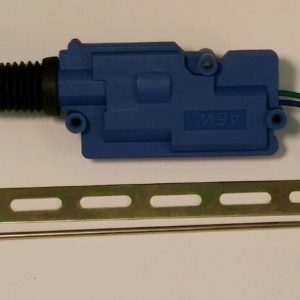
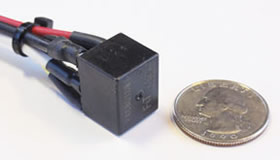
But relays can also be used as a versatile switch. After all, a relay is just a switched-switch. That is, one switch (in this discussion that would be the remote control) is triggering the relay to switch power on or off (or both) to another circuit or circuits. In the simplest cases we do that because the relay can switch big amperage, 30 or 40 amps, that the remote control isn't capable of switching. With door latch releases for example, we push the remote button, it triggers the relay to turn on and to power the door solenoid and when we release the button it stops. The small amperage remote triggers the high amperage relay which sends a positive blast to the solenoid and the door latch is opened. This type of relay is a 4-tab relay, correctly known as a "Form A" or SPST (single pole -single throw) relay, which means that in it's power switching circuit the relay has one input (single pole) and one switched output (single throw).

Door lock/unlock is a different situation, however. You need to be able to push one button and have the lock actuators pull (lock), and push another button and have the lock actuators push (unlock). The two lock actuators are wired in parallel so that both doors lock/unlock at the same time. To get the actuators to pull you need to energize
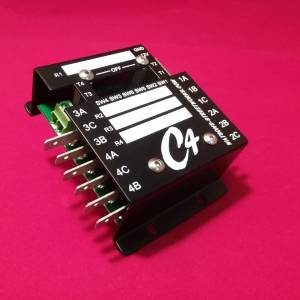
them with one polarity (+1- orientation on the wires), and for push you need to reverse that polarity (to -1+ orientation). Since the remote control only puts out a single signal, you need relays to provide both (+) and (-) signals to the actuators. A 2-relay pack (properly wired of course) often referred to as a polarity reversing module does the
trick. Hot (+) and ground (-) are fed to the module as well as the two remote control triggering outputs (lock/unlock). Depending upon which of the remote buttons is pushed, and therefore which trigger is activated, the module responds accordingly to provide lock polarity or unlock polarity to the actuators.

Remote controlled power windows work exactly the same way, except you'll need a four function remote and a separate module for each window, up and down for each independently. Of course there's a catch. If either the remote power locks or power windows are being used with 5-wire switches on the inside, the module wiring must be
different.

The most common type of power lock and power window switches used are called 5-wire switches because...well, they have 5 wires attached, a hot (+) feed, two ground feeds and the two output wires that go to the window motor. There are some 4-wire switches that internally join the ground feeds, and there are 6-wire and 7-wire switches
that add an illumination feed and occasionally it's own ground. They're still all "5-wire" switches. These switches are capable of reversing the output polarity on their own. The catch has to do with an extra design feature that someone must have considered a safety thing.

When 5-wire switches are in the "off" position, both of the output motor leads are grounded through the switch. If we try to power the motor from another switching source, like our remote/module combination, but don't disconnect the switches grounded lead, we create a direct short to ground and we fry a fuse. (We did remember to protect our circuit with a fuse, now didn't we?) Again, the solution is a relay.

The relay used in this case is a 5-tab relay, correctly known as a "Form C" or SPDT (single pole -double throw) relay. As before, it has one input (single pole) but two switched outputs (double throw). One output is normally closed (and opens, or disconnects) when the relay is triggered, and one output that is normally open (and closes, or connects) when the relay is triggered. If we put the relay into one of the motor lead wires, we can use this flip-flop action of a SPDT relay to (1) disconnect the switch ground lead and (2) reconnect that motor wire to a hot feed all in one remote
triggering of the relay. Since the second motor lead is still grounded through the switch, the motor gets its +1- and rolls down. In order to get the motor to roll up, we need a second relay wired into the other motor lead wire so that when it is triggered by a different remote output, it gives the motor a -1+ polarity and the window rolls up.

Still another kind of relay that can be very useful is a latching relay. All of the other applications we've discussed have needed momentary switching, that is, the power to release a latch, lock a door or roll down a window is only on momentarily while we hold the transmitter button. On the other hand, a latching relay can take a momentary
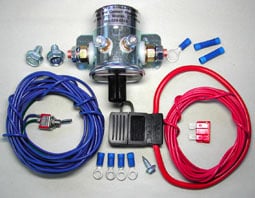
signal and turn a circuit "on" and keep it there even after the triggering signal has stopped, then turn the circuit "off" the next time the monetary triggering signal is applied. Latching relays can be used for alarms, auxiliary lights and battery
disconnects, just to name a few applications.

I haven't gone into great detail or wiring schematics, here. It's most important for people to simply understand the concepts and to realize that the remote control is only one piece of the puzzle, just the trigger for the real action. But, this does remind me of some strong suggestions for consumers who are about to get into remote controls or
any electrical goodies.

First, if you know what you want to end up with before you start buying stuff, you're less likely to shelve unneeded parts. (What? You mean I have to plan this project?) No, you don't have to plan ahead if you don't want to, but you'd better be tolerant of aggravation if you don't. It's not uncommon to have customers ask, "I bought this part
last month but it won't work with this other part I bought three months ago at a swap meet. Why not?" To which I usually respond that they weren't meant to work together, and, "What did you want to achieve?" We can almost always get them to where they wanted to be, but their diversion could have been prevented by better planning up
front.

The second suggestion is to get all the related parts from a single source if at all possible. You want remote power windows with inside switches? You want to unlatch both doors and have a remote battery disconnect? One stop shopping will increase the likelihood of getting "matching" parts and all of the parts you need. Unless you know what you're buying, resist the swap meet deals to pick up one or two pieces real cheap. Besides, electrical parts can hide flaws. A $79.00 remote control could be an expensive trash can ornament. And second owner parts are not covered by warrantee. Third, realize that all remote controls are not alike, nor are they intended for the same
uses. Many remotes come with no relays what so ever, some require you to program the unit. Others come with relays, but you have to do all of the wiring connections and the relays may not be able to handle enough amperage for your job. Still others are intended for specific purposes like power windows or door release. Again, if you know
what you want and need, you're way ahead of the game.

And finally, ask questions as you go. You will learn both about the parts in question and about the person answering your questions. Go with suppliers who can and will provide you with all of the answers to your questions as well as all of the parts that you need.

Copyright (c) 1999-2009 Watson's Streetworks Designed by WebLandHosting, LLC